The fascinating history of the wall clock: From the sun to pendulum clocks
Summary of the main information in the text:
Summary
- 1. The origins of time measurement
- 2. The Birth of Wall Clocks in the Middle Ages
- 3. The Golden Age of Wall Clocks: From Craft to Industry
- 4. The wall clock: between symbolism and innovation
- 5. Conclusion
- 6. Additional Resources
1. The origins of time measurement

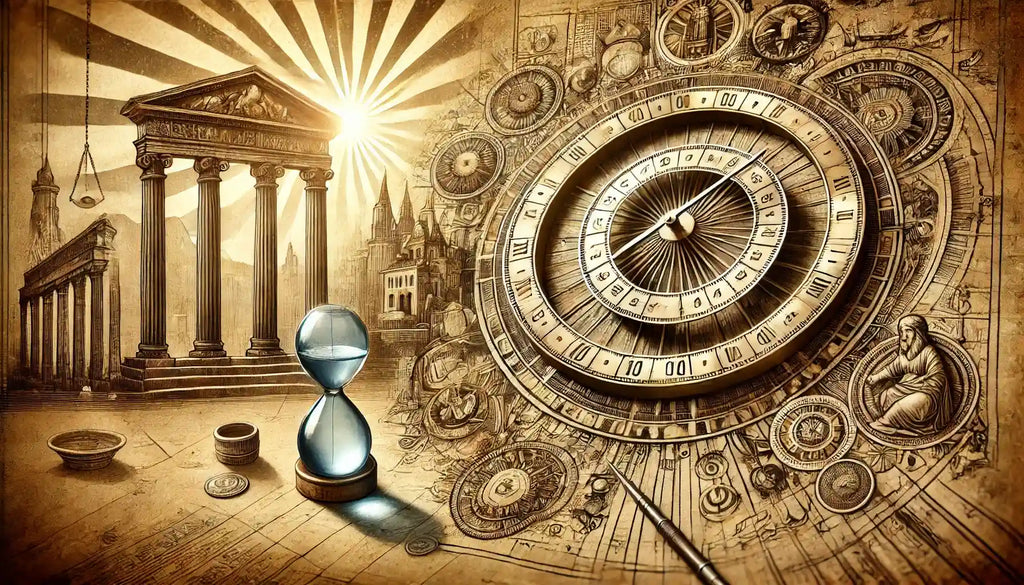
Before the invention of wall clocks, ancient civilizations strove to measure and track time using ingenious techniques. These primitive methods laid the foundation for the timekeeping systems we use today.
- Sundials: Invented by the Egyptians more than 3,500 years ago, they use the shadow cast by the sun to indicate the time. They symbolize one of the first attempts to capture time.
- Water clocks: Also called clepsydras, these devices were used in China and Greece to measure time by means of a constant flow of water into a graduated container.
- Time candles: In the Middle Ages, graduated candles made it possible to track the passage of time in environments where sunlight was not accessible.
These innovations demonstrate the ingenuity of ancient civilizations and their quest to organize their daily activities.
2. The Birth of Wall Clocks in the Middle Ages

With the rise of great European civilizations, the measurement of time evolved to meet religious, social, and economic needs. It was during the Middle Ages that the first mechanical clocks appeared.
- Church clocks: Installed in bell towers, they served to regulate prayers and community activities. These early mechanical clocks used weights to power the mechanism.
- A symbol of prestige: Monumental clocks were often commissioned by wealthy cities to demonstrate their prosperity and technological advancement.
- The dissemination of knowledge: Innovations in watchmaking were often shared between monasteries, which were both places of study and prayer.
Wall clocks began to emerge in the private residences of nobles, marking a transition to a more personal use of these devices.
2.1 Technical innovations of the Middle Ages

The Middle Ages saw significant advances in clock design, marking a turning point in their use and development. Among these innovations were:
- Gear mechanisms: Inspired by Greek and Roman works, medieval craftsmen perfected the use of gears to transmit movement to the hands.
- The use of weights: Medieval mechanical clocks used suspended weights to provide the energy needed to operate them, thus eliminating reliance on water clocks or the sun.
- Astronomical clocks: Some sophisticated models indicated not only the time, but also the phases of the moon and the positions of the stars, like the famous clocks of Prague or Strasbourg.
These advances have transformed clocks into true works of art and technology, while also making them more practical and reliable to use.
3. The Golden Age of Wall Clocks: From Craft to Industry
3.1 The Renaissance and the rise of wall clocks

During the Renaissance, clockmaking experienced unprecedented growth thanks to scientific and artistic advances. The wall clock became a prestigious object in wealthy homes and its production diversified.
- Sophisticated designs: Clocks were often adorned with intricate patterns and gilding, reflecting the wealth of their owners.
- Increased accuracy: Watchmakers have begun to incorporate technologies such as the balance spring to improve the accuracy of clocks.
- Distribution across Europe: Watchmaking centers, such as those in Geneva or England, emerged, becoming benchmarks in terms of quality and design.
This period marked the beginning of the popularization of wall clocks, which gradually left palaces to be installed in bourgeois homes.
3.2 Industrial Revolution and Mass Production

With the industrial revolution in the 18th century, clockmaking benefited from new tools and production methods, transforming the wall clock into an object accessible to a wider audience.
- Mass production: The introduction of machines made it possible to produce clocks in large quantities, thus reducing their cost and making them accessible to the middle class.
- A variety of styles appeared: Models adapted to different tastes and budgets appeared, from simple wooden clocks to more ornate designs in metal or porcelain.
- Global export: Clocks produced in Europe and the United States were exported worldwide, boosting their popularity.
This period marked a democratization of the wall clock, which went from being a symbol of luxury to an everyday object, present in many homes.
3.3 The wall clock in the contemporary era

In the 20th century, the wall clock continued to evolve to adapt to the needs and tastes of consumers. Its function now goes beyond simply measuring time to become a true object of decoration and technology.
- Modern and minimalist styles: Contemporary designs favor clean lines, innovative materials (such as plastic or stainless steel) and neutral finishes that easily integrate into any type of interior.
- Smart clocks: With the rise of technology, smart wall clocks allow you to synchronize the time via the Internet, display weather forecasts, or even control other household devices.
- Vintage models are back: Replicas or restorations of clocks from past eras are experiencing a resurgence in popularity among retro style enthusiasts.
The modern wall clock is at the crossroads between tradition and innovation, offering both practicality and aesthetics.
4. The wall clock: between symbolism and innovation

Beyond its functionality, the wall clock embodies values and concepts that have evolved over time:
- A symbol of passage: It represents the fleeting nature of time, reminding everyone of the importance of each moment in a world in perpetual motion.
- A family heirloom: In many cultures, wall clocks are passed down from generation to generation, symbolizing continuity and family ties.
- Constant innovation: From atomic clocks to solar models, the quest for precision continues to motivate engineers and designers.
Combining nostalgia and futurism, the wall clock is a timeless witness to our relationship with time and its organization.
5. Conclusion
From the sundials of ancient civilizations to today's smart clocks, the wall clock has come a long way. It illustrates our ability to innovate while maintaining a connection with the past. Both practical and decorative, it continues to evolve to adapt to our modern lifestyles while enhancing our interiors.
💡 Whether you are passionate about history or a fan of contemporary design, the wall clock remains a must-have, uniting functionality and aesthetics in perfect harmony.
6. Additional Resources
-
Posted in
horloge-murale-pendule